When to Aerate Your Lawn in Elizabeth, CO (And Why It Matters)
If you live in Elizabeth, Colorado, you're dealing with one of the most demanding lawn environments on the Front Range. At 6,300 feet, the soil in Elbert County skews heavily toward clay — dense, compact, and slow to drain. That clay is great for growing weeds and terrible for growing a thick, healthy lawn unless you stay on top of one critical maintenance task: core aeration.
We get asked constantly about timing. "Should I aerate in spring or fall?" "Is it too late?" "My lawn looks terrible — will aerating help?" This guide gives you the straight answer for Elizabeth specifically — not generic lawn advice, but what actually works here.
Fall Is Your #1 Aeration Window
For the cool-season grasses that dominate Elizabeth lawns — Kentucky bluegrass, tall fescue, and perennial ryegrass — fall is hands-down the best time to aerate. Specifically, mid-September through mid-October hits the sweet spot in Elbert County.
Here's why fall works so well:
- Cool-season grasses have a natural growth surge in fall. Aeration coincides with this burst, accelerating recovery.
- Soil temps are still warm enough (above 50°F) for roots to grow into the newly opened channels.
- The summer heat stress is behind you, so the lawn isn't in a weakened state when you punch holes in it.
- It's the best window to overseed at the same time — seed falls into the aeration holes and germinates before freeze.
- Overseeding in fall means the new grass has a full spring growing season ahead of it before summer stress hits.
In Elizabeth, we typically push customers to aim for late September as the sweet spot. It gives the lawn 3–4 weeks of good growing weather before the first hard frost (which in Elbert County typically arrives around October 5–20). Don't wait until October 15 — you'll lose the post-aeration recovery window.
Spring Is a Solid Secondary Window
Spring aeration works too — just keep a few things in mind for Elizabeth's climate. At 6,300 feet, don't be in a rush to get out there in early April when it looks like spring. A late freeze, which Elizabeth gets regularly through mid-May, can stress freshly aerated turf.
Wait until April 15 – May 15, when nighttime temperatures are consistently above 40°F and the ground has completely thawed. Aerating while the ground is still semi-frozen in March is pointless — the tines won't pull proper plugs from frozen soil.
Spring aeration pairs well with a starter fertilizer application. The open channels let fertilizer reach the root zone directly instead of sitting on top of a thatch layer.
How Often Should You Aerate in Elizabeth?
Most Elizabeth lawns benefit from aerating at least once per year. For lawns on heavy clay, high-traffic areas (kids, dogs), or lawns that have gone several years without aeration, twice per year (spring + fall) makes a visible difference.
Signs your lawn is overdue for aeration:
- Water puddles or runs off instead of soaking in
- The lawn feels hard and springy underfoot (like a sponge — that's thatch)
- Thin, patchy grass despite regular watering and fertilizing
- Grass turns brown quickly in summer despite irrigation
- You can't easily push a screwdriver 2 inches into the soil
What Happens During Core Aeration
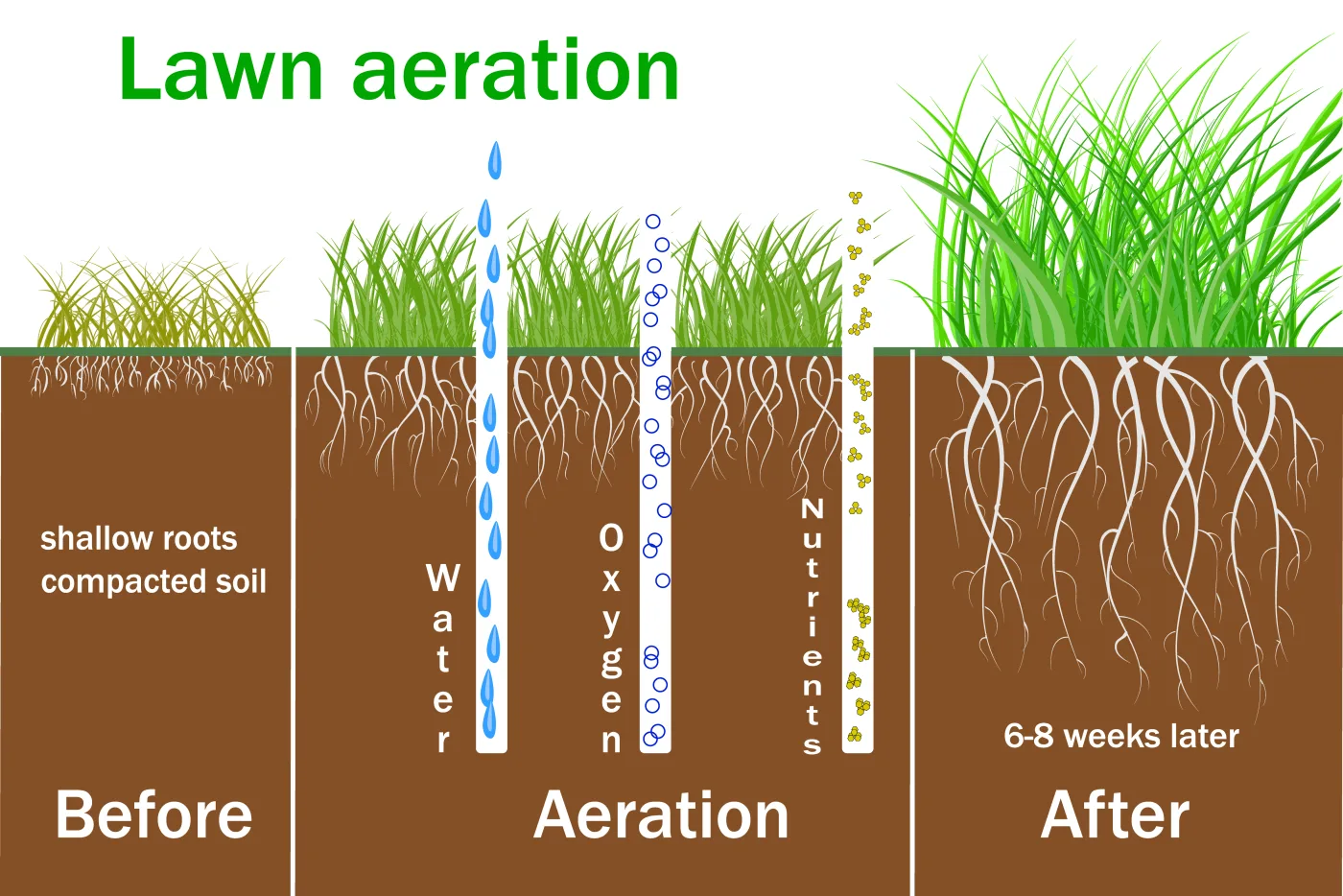
A core aerator is a machine that drives hollow tines into the soil, pulling out plugs roughly 2–3 inches deep and 0.5 inches in diameter. These plugs are deposited on the surface of the lawn. They look messy for about 2 weeks, then break down and return organic matter to the soil. Do NOT rake them up — they're beneficial.
After aeration, your lawn will have thousands of small holes across the surface. These channels allow:
- Oxygen to reach root zones
- Water to penetrate instead of running off
- Fertilizer to access roots directly
- New grass seed to make soil contact (if overseeding)
Should You Overseed at the Same Time?
In most cases, yes — especially in fall. Overseeding after aeration is the most effective way to thicken up thin Elizabeth lawns. The aeration holes give seed the soil contact and moisture retention it needs to germinate. Broadcast seeding on un-aerated ground has a much lower germination rate because seed tends to wash away or dry out before establishing.
For Elizabeth lawns, we recommend a tall fescue blend with some Kentucky bluegrass — the fescue handles the dry Colorado summers better than pure bluegrass while still giving you the color and density you want.
What to Do Right After Aeration
- Water: Run your sprinklers that same day or the next morning — 30–45 minutes per zone. Keep the lawn consistently moist for 2 weeks if overseeding.
- Fertilize: Apply a starter fertilizer (high phosphorus for root growth) within a week of aeration.
- Mow: Wait 2 weeks before mowing again after aeration + overseed. Let the new seedlings establish.
- Leave the plugs: They break down on their own and feed the soil.
Ready to Schedule Aeration?
We serve Elizabeth, Parker, Franktown, Kiowa, and Elbert County. Fall slots fill up fast — text or call to get on the schedule.
Get a Free Quote →